From SEO to GEO: the new front door
Guests now ask AI where to eat and drink before they ever see your website. SEO is about being found by humans. GEO is about being understood by machines. Here is what that changes.
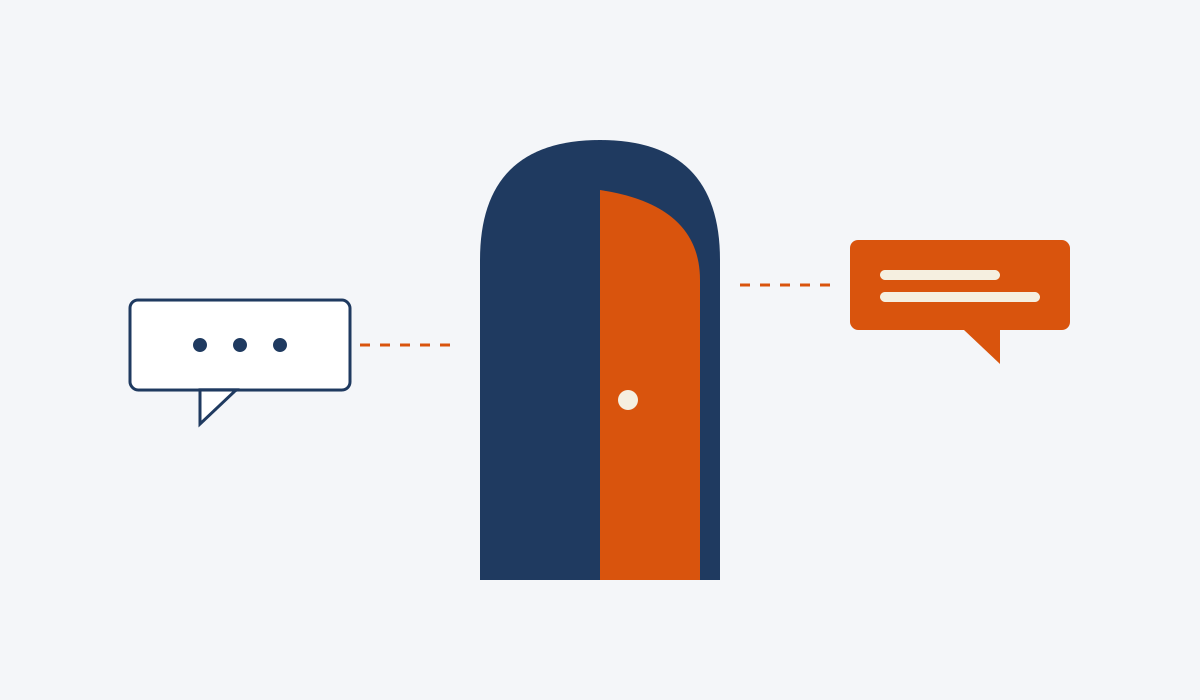
Google is the new front door. That has been true for a decade. What changed this year is who answers the door.
Ask your phone “where is the best Sunday roast near me with a garden?” and increasingly the answer is not ten blue links. It is one written answer, assembled by an AI, naming two or three places. Google’s AI Overviews, ChatGPT, Perplexity. The trade calls these answer engines, and they are exactly that: they don’t list candidates, they answer the question.
If your pub is not in that answer, you were not considered. The guest never knew you existed, and you will never see the lost booking in any report.
Being found is no longer enough
SEO is about being found by humans. GEO, generative engine optimisation, is about being understood by machines.
The difference matters. A human landing on your website can forgive a lot: they will scroll, squint at a menu PDF, work out that “kitchen closes at 9” probably means food until 8.45. A machine will not. It reads what is structured and skips what is not. If your opening hours, menus, prices, dog policy and garden are not written in a form a machine can parse, then as far as the answer engines are concerned, those facts don’t exist.
This is not a dark art. It is mostly unglamorous housekeeping:
- Structured data. The schema markup on your pages that tells a machine “this is a pub, these are the hours, this is the menu, here is the booking link”. Most hospitality sites have either none or a broken scattering of it.
- One source of truth. The same facts, consistent everywhere the machines look: your site, Google, the listings services. Contradictions make a machine drop you rather than choose between versions.
- Answering real questions. The machines are answering “can I bring the dog”, “do they do gluten free”, “is there parking”. If your site never says it, you are invisible for every question you never answered.
You can measure this
Most operators have no idea how they show up in AI search, because nobody has looked. It can be audited: ask the engines the questions your guests ask, see who gets named, trace why. When I run this exercise, the gaps are usually specific and fixable, and the fixes are ordinary work: structured data, consistent facts, filled-in answers.
It’s not rocket science. It is discovery moving house. Your pub either moves with it or gets left behind.
The warm welcome still wins the repeat visit. But the machines now decide who gets the first one. Make sure they understand what you already do brilliantly.
What leaders should do next
- Ask the questions your guests ask AI: Sunday roast, dog friendly, garden, parking, gluten free, private hire. See whether your venues are named.
- Check whether your core facts are machine-readable: opening hours, menus, booking links, facilities, dietary info and location data.
- Remove contradictions across your website, Google profile, listings and booking platforms. Machines drop messy facts.
- Treat GEO as basic housekeeping, not a marketing trick. The guest still chooses the pub, but AI may now choose the shortlist.