The octopus or the ammonite: an operator's read on AI in pubs
Stephen Wunker and Jonathan Brill's octopus model, read by the person who runs both the tech stack and the cellar. Push intelligence to the arms, wire the nervous system, or go the way of the well-armoured shellfish that went extinct.
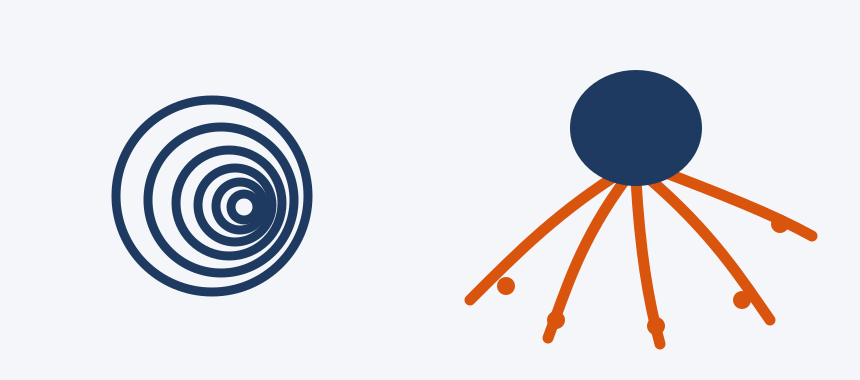
There is a creature that got defence exactly right and still died out. The ammonite built a beautiful coiled shell, armoured against every threat it knew, and thrived for millions of years. Then the water changed, and being brilliantly protected against yesterday counted for nothing. Its soft-bodied cousin, the octopus, survived. Not because it was tougher, but because it thinks differently. Two thirds of an octopus’s neurons sit not in its head but out in its arms. One arm prises open a clam while another feels along a cave wall, each acting on its own, all strung together by a nerve ring.
In AI and the Octopus Organization, Stephen Wunker and Jonathan Brill turn that biology into a warning for firms. Become the octopus or become the ammonite. If you are the person in a pub group who owns the tills, the rota software, the stock system and the broadband that holds it all together, this is your book, because the octopus is not a metaphor for culture. It is a systems diagram.
Eight arms: push the decision to where the hands are
The octopus does not route every choice through a central brain. Nor should your estate. The book’s first move, Eight Arms, is about pushing decisions to the frontline and giving that frontline the tools to act. In a pub that is the difference between a manager waiting for head office to approve a price change on slow-moving stock, and a manager whose system already suggests the markdown and lets them take it.
The technical read is sharper than empowerment posters. It means your data has to be available at the edge, in the manager’s hand, in a form they can act on during service, not in a report someone reads on Monday. If the intelligence only lives in the head office brain, you have built a vertebrate, and vertebrates are slow.
The neural necklace: your silos are the real bottleneck
The octopus’s arms are useless in isolation. The nerve ring, what the book calls the Neural Necklace, is what lets one arm know what the others have found. For most pub operators this is the honest weak point. The booking system does not talk to the till, the till does not talk to stock, and stock does not talk to the staffing model. Every silo is a severed arm.
AI does not fix this on its own. It makes the cost of the gaps brutally visible, because a model is only as good as the connections it can see across. The job for the technical lead is unglamorous and it is the whole game. Wire the nervous system before you buy the clever brain. Connected ordinary data beats brilliant data trapped in a box.
Three hearts: the boring one keeps you alive
An octopus has three hearts, and the book borrows them to argue that a firm has to balance three things at once. Rigorous analysis, quick agility, and the human culture that carries the change. The one operators skip is culture, and it is the systemic heart, the one that pumps to the whole body. You can ship the best rollout in the sector and watch it die because the people at the pumps do not trust it.
What leaders should do next
- Map your severed arms first. Before any AI spend, list which of your core systems cannot see each other. That gap list is your real roadmap.
- Move one decision to the edge. Pick a single choice a manager currently escalates, give them the data and the permission to make it during service, and measure what happens.
- Fund the plumbing, not just the brain. Budget for the integration work that connects your systems. It is the least exciting line and the one that decides whether the clever tools work at all.
- Bring the human heart in early. Put the people who will use the tool in the room while it is being shaped, not after it is built. Trust is not a launch-day problem.
The window the authors describe is narrow, the next few years, and the choice is stark. You can keep polishing the shell, or you can start wiring the arms. One of those creatures is still here.